

delabs circuits
Electronic Engineering Schematics
Discussion of Sequential Timer Part A - doc00035
The below conversation exported from eudora my email client is related to a simple open source project project. This has been published for educational reasons, You can study and judge for yourself if this is the way it ought to be done, or is there a better way. But one thing is to be understood is that this is just a record of how i did it and may have some errors and some useful information. So hope it helps in learning. That is what delabs is all about.There are many Instruments and Industrial products at - Platt Electric - Electrical Distributor
This project is to make a Solenoid will move forward and backward or it could be used to turn off and on a relay or motor. It could also be used to change direction of motor rotation with two adjustable time periods.
- Discussion of Sequential Timer - A
- Discussion of Sequential Timer - B
- Sequential Timer Specs
- Two Stage Sequential Timer
- Li-Ion Battery Charger
I’m working on a small electronics project but don’t know too much about designing circuits so I figure I would ask someone who knows and this seems like the place. Ok, What I’m looking for is the following: I need a circuit that when the switch is pressed it will close the circuit and in an adjustable amount of time via adjustment knob: I’m not sure what the name of the adjustment component is called but its: (A small box shaped component that can be adjusted using a small screw driver. In a circular clockwise motion to speed up the time and counter-clockwise to slow it down) a solenoid will actuate and move in the forwards direction. Then for an adjustable amount of time via adjustment knob will return to its starting position, which will require the voltage to be reversed.
See a Timer that can be used in such applications - Multifunctional counter and timer- Autonics
The circuit will need to automatically restart itself, and then when the switch is closed it will repeat the operation again. Can anyone out there help me? If so please don’t hesitate to send me an email or instant message I would really like to get this project going.
In simpler terms:
1) Press button
2) After (1-30 seconds) adjustable delay1 - solenoid activates forward
3) After (1-30 seconds) adjustable delay2 - solenoid activates backwards
4) Resets and wait for press of button again
If stationary time is needed I would like delay 1: 5 seconds
and delay 2: 1 second. Solenoid Spec’s can be viewed below: I
would also like the push button switch and solenoid to be
attached to the circuit via “Terminal blocks” It would be nice
if the PCB it was designed on was a .73” diameter circle with
a .15” hole down the center but since this is a prototype it’s
not a big what shape/size it is.
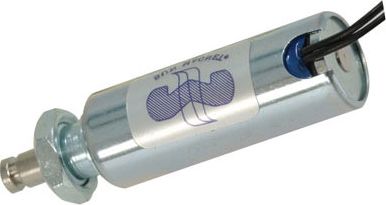
Solenoid Spec’s:
- 12VDC Continuous Tubular Push/Pull Solenoids
- 12VDC nominal voltage continuous
- Life expectancy: 2,000,000 cycles
- Nominal voltage and current is at 100% continuous
- Voltage/Current: 12VDC @ 135mA
- Type: Push/pull
- Coil Res(+10%): 89 Ohms
- Size: 1.24" L x 0.73" Dia.
- Weight: 0.05 lbs.
- Shaft Dia. (in.) 0.110
- Wires (in.): 3.5
- Power Consumption.: 2.0W
- Holding Force (lbs. @20 degrees C): 1.12
I can provide you with a circuit-schematic in pdf format and an idea of how to use it. You have to fabricate the PCB and make the product yourself.
The product you need is a Sequential Timer, This will be available in most industrial dealers. But you should know how to wire it up and some tricks with the relay outputs.
If these are not available or expensive you can try these circuits that i built for such work.
see these circuits on my page Digital Timers Counters and Clocks
analog timer, 4541 -- toaster timer, 555 -- Sequential Timer
delabs
Back to Design Service and
Projects
Wow!, thanks for the prompt reply! If I were to have you do the schematic drawing can you give me an estimate on the price? I searched PCB prototypes and came up with about 30 contacts so I’m almost positive finding someone to make the circuits wont be to hard and I really don’t mind waiting. In the mean time I will just machine the other parts to the project and get them all ready. I also forgot that the “power in”would be via a terminal block also.
I do a lot of designing in SolidWorks and have the program CircuitWorks I don’t know if you’re familiar with the program but it will take a standard IDF file and build it in 3d on a PCB with all the components. I was hoping that an IDF drawing is what kind of drawing I would receive so I can put the computer chip in my 3D demonstration. Thanks a bunch for your time and I am really looking forward to doing business with you in the near future.
reply from RHThe Circuit documents will be made available free of cost,
but there will be service charges. The Circuit will be in both
Orcad and pdf formats and others in pdf or text if any.
This circuit will be open source and will be published in my
website also and will be available to all. You have to know
that the circuits and documents will be seen by all visitors
to my website.
delabs
I received the Solenoid from the link I gave you today and it's not going to be the one used for the project I have in mind. for a few reasons: The solenoid doesn’t actuate in the opposite direction when the voltage is reversed. Two the solenoid is too small and lastly the solenoid does not have enough Foot pounds of force for the operations. So I'm going to inquire on a different, more powerful one that should fit the application fine.
This may also mean the circuit would not need to have delay two reverse the current instead it would just have to stop the current, reset the circuit and get it ready to repeat the operation for the next push of the button. I will look more into this and see if I can get a solenoid to fit my specifications and get back to you with a final plan for the circuit. Open source is no problem, price is no problem. Thanks!
reply from RH
A draft Specifications has been made and attached to this mail. There are both html and pdf versions. You can study them and make the required specs or tell me the changes. The specs are in an electronic point of view not mechanical. When the specs are frozen and approved by you, we can start.
Two Stage Sequential Timer
delabs
Sorry for the delay the new solenoids have arrived and there is a change in the circuit. The change has been made for simplicity as well as battery consumption. Please review the description and get back to me. Thanks!
Description:
The circuit is a Two stage sequential timer with auto reset.
Sequence Of Operation -1. Power on the Circuit.
2. If Start switch is pressed.
3. Then after Timer Delay T1 Secs the Solenoid Operates in Forward Direction.
4. Next after Timer Delay T2 Secs the Power is cut off, and the Timers are Reset.
6. Circuit Ready for next press.
All Timers are 1 - 30 Secs Analog with Presets to adjust with a screwdriver. The Switch, Solenoids and Power supply has to be via terminal blocks.The PCB may be up to four Square Inches for standard DIP components but with SMD it may be smaller.Solenoid Specifications -
Volts - upto 50V Current - up to 1A or 1000mAType Push-Pull on Reversal of Polarity.
reply from RHAttached are the specs for approval, with the changes you
have indicated. The circuit can be designed and sent to
you after you approve specs. Two Stage Sequential Timer
waiting for the specs approval
delabs
I have a just a few more questions before I approve this. Is it possible to have an LED indicator so I would know when the Solenoid is about to engage? For instance a yellow LED to illuminate when the activation switch has been push and T1 has been activated, followed by a Red LED with an adjustable amount of time before the Solenoid engages say 1-5
seconds? I was also looking through my Jameco electronics catalog and see that they have these rotary dip switches with numeric digits on them so you would know what time you have set. Can these be integrated into the circuit instead of standard ones? Thanks once again for your time and if you have any questions please feel free to ask.
reply from RH
We can have one LED yellow turned on when you press the start
switch and Timer T1 is started. This yellow LED will turn off
when both timers are RESET and cycle is complete and solenoid
is off.
We can have another red LED to show the solenoid has been
powered, and will go off when solenoid is off.
These LEDs above can be put without adding much circuits,
other LEDs with delays need more circuits.
The Rotary dip switches may not be useful here, as they may
not give a smooth control. You can use preset potentiometers
with markings or graduations if they are
available.
...
...
...
...
...
delabs Technologies
20th Mar 2020
...
The documents, software, tools and links are provided to enhance the ability of an electronics student, hobbyist or professional by sharing information. The information, links etc. should be used by the website visitor, at his or her own risk and responsibility. There may be concept, design and link errors in the pages.
Creative Work, ideas and documents of delabs can be used for Product Design and Development by R&D Engineers, Hobbyists, Students and even firms for creating useful products. These cannot be used for reprint, replication or publishing online or offline.